
- English
- Dansk
Games that turn company values into everyday behaviour
Most change efforts stall on people, not plans. A game lets leaders and teams feel what resistance, uncertainty and momentum are like, and talk about it, before the real change is on the table. We make board games for change and leadership: one you can use tomorrow, and others built around your own situation.
Change Navigator: lead an organisation through change in an afternoon
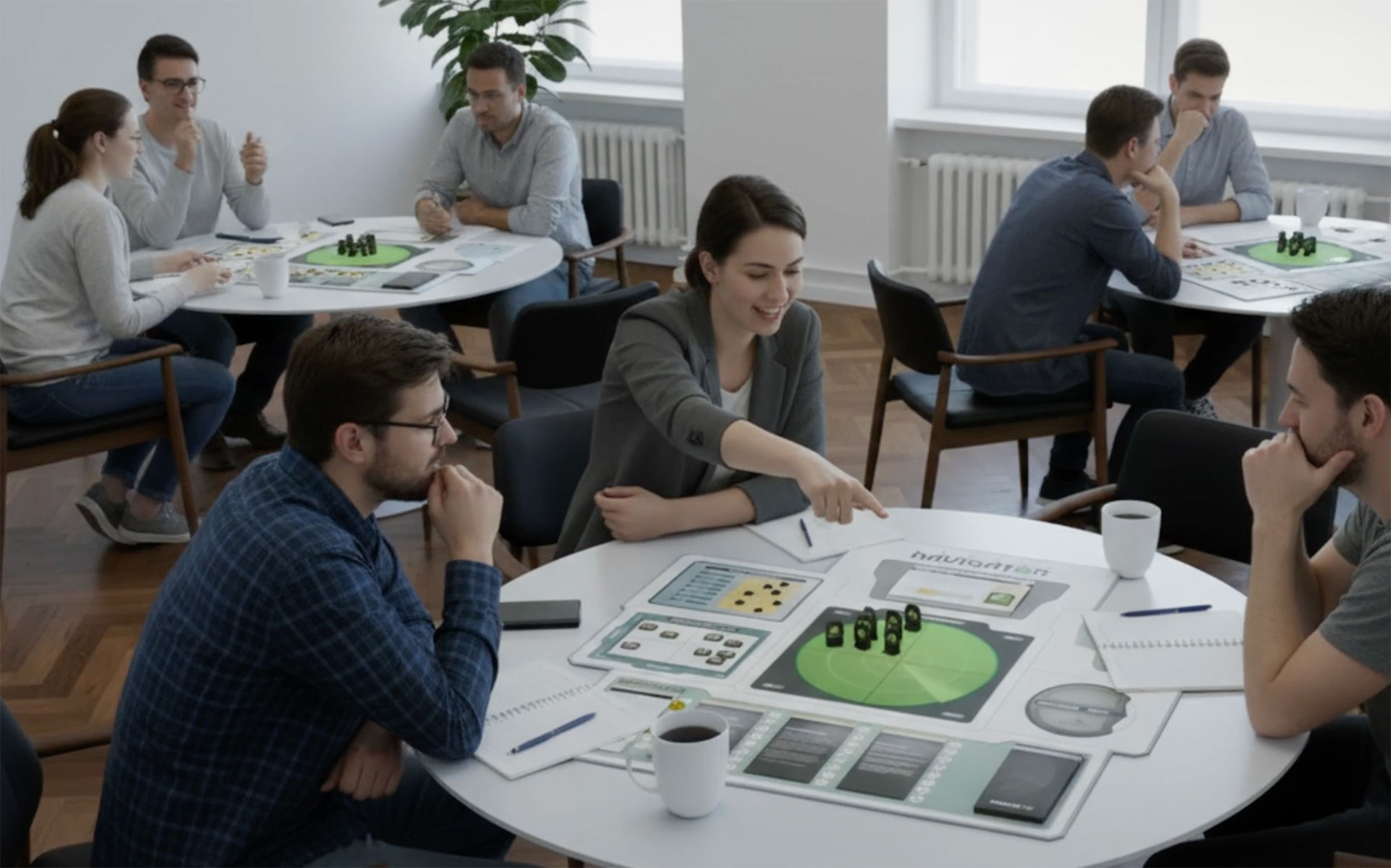
Change Navigator puts leaders into a simulated change project. Around each board, 3 to 7 players work together to bring an organisation through a change, and see the consequences of their choices along the way. The game is case-based, so you can play a change in a private company, a hospital or a municipality. Boards play side by side, so a team of five or a conference of a hundred can take part. It was named Game of the Year and Most Original Game at the International Business Learning Games Competition in 2017.
| Players | 3 to 7 per board; several boards in parallel |
|---|---|
| Duration | 2.5 to 5 hours |
| Languages | English, German, Danish, Polish, Lithuanian |
| For | Leaders and change agents in medium-sized and large organisations |
| Price | From EUR 550 for a first session |
Consultant or trainer? See how to become a partner.
Change Navigator has been used by Adidas, Arla, BC Hospitality Group, Carlsberg, DI, DSV, ISS, JYSK, Mexichem, MHI Vestas, MT Højgaard, Niras, Pandora, Region Hovedstaden and Solaris Bus & Coach.
Why change feels harder than the plan says
A change that looks logical on paper lands differently in each part of an organisation. Research by the Swedish psychologist Claes Janssen describes how people and groups tend to move through four states when something changes: contentment with how things are, denial that anything needs to change, confusion when the old way no longer works, and renewal when a new way starts to make sense.
Contentment
With how things are.
Denial
That anything needs to change.
Confusion
When the old way no longer works.
Renewal
When a new way starts to make sense.
Groups do not move through these states at the same speed. Leadership has often reached renewal while most of the organisation is still in denial or confusion. Change Navigator is built around that gap: leaders practise bringing a whole organisation along when its parts are in different places.
Six ways of thinking about change, and what each is good for
Change management has a handful of models that keep coming back. They differ less in what they claim than in what they look at: some describe what leaders do across the organisation, others what happens inside each person. Follow the links to read more about each one.
| Model | Core idea | Looks at | Most useful for |
|---|---|---|---|
| Lewin's three steps | Unfreeze, change, refreeze | The organisation | Explaining why preparation and anchoring matter |
| Kotter's eight steps | A sequence from creating urgency to anchoring the change in culture | The organisation | Planning and leading a large programme |
| ADKAR (Prosci) | Awareness, desire, knowledge, ability, reinforcement | The individual | Finding out why one person or group is stuck |
| Bridges' transitions | Ending, neutral zone, new beginning | The individual's inner transition | Understanding loss and uncertainty during change |
| Janssen's research | Contentment, denial, confusion, renewal | Individuals and groups | Seeing where different groups are, and what each needs |
| Maurer's levels of resistance | "I don't get it", "I don't like it", "I don't like you" | The response to change | Choosing how to respond to resistance |
A note on Lewin: he wrote about unfreezing, moving and freezing in a 1947 article, but researchers have shown that the neat three-step model was largely put together by others after his death (Cummings, Bridgman and Brown, 2016).
No single model is enough. Plans need Kotter's discipline; people need the attention that Bridges, Janssen and Maurer describe. A game is a way to practise holding both.
The evidence behind practising change
Change Navigator rests on a simple idea: people learn to lead change by doing it and talking it through, not by being told. Here is what current research says about that idea, and about change more broadly.
| Question | What the research shows | What it means in practice |
|---|---|---|
| Does taking part beat listening? | Yes. Across 225 studies of university teaching, students in active classes scored about half a standard deviation higher, and students in lecture classes were 1.5 times more likely to fail (Freeman et al., 2014). The same holds at work: in 95 studies covering some 21,000 employees, the more a training method engaged people, the more they learned and the fewer accidents and injuries followed, with practice and dialogue doing best (Burke et al., 2006). People also tend to feel they learn less in active sessions even when they learn more (Deslauriers et al., 2019). The idea goes back to Kurt Lewin's group-decision studies in the 1940s (Lewin, 1943). | Put leaders to work on a change instead of presenting one to them. It will feel harder than a talk, and that effort is part of the learning. |
| Do games and simulations work? | On average, yes. A meta-analysis of serious games found more learning and better retention than conventional instruction, most of all when the game was combined with other instruction, played over several sessions and played in groups (Wouters et al., 2013). For simulation games in workplace training, confidence in one's own ability was 20% higher, knowledge 11-14% higher and retention 9% higher than in comparison groups (Sitzmann, 2011). Leadership training in general works best when it includes practice, feedback and face-to-face delivery (Lacerenza et al., 2017). | Play in groups, and give the debrief as much weight as the game. These studies are mostly of digital games; board games for change leadership have not yet been studied on their own. |
| Why does a safe place to practise matter? | Teams learn when people feel safe to speak up, ask questions and admit mistakes. In a field study of 51 work teams, psychological safety went together with learning behaviour, and learning behaviour with team performance (Edmondson, 1999). A meta-analysis of 136 samples with more than 22,000 people confirms the link to performance at work (Frazier et al., 2017). Teams also do better when members share a picture of the task and of each other: across 65 studies, shared team cognition was strongly related to team performance (DeChurch and Mesmer-Magnus, 2010). | A game lets leaders try decisions, get them wrong and talk about why, at no cost to the real organisation. It also gives the group a shared language to use when the real change starts. |
| How do people react to change? | A review of 79 studies describes reactions as having three sides - what people think, feel and do - shaped by the person, the workplace, how the change is run and whether people expect to gain or lose (Oreg, Vakola and Armenakis, 2011). Where you sit matters: in a study of a major change at a large hospital, executives were less negative than supervisors and other staff (Jones et al., 2008). | Do not expect one reaction. Levels and groups will be in different places, and the four states above give leaders a language for that. |
| What do successful changes have in common? | A review in the Academy of Management Annals held seven popular change models up against the research and arrived at ten evidence-based steps for managing planned change (Stouten, Rousseau and De Cremer, 2018). | The well-known models each cover part of the picture, which is why the table above compares several instead of picking one. |
| Can small changes in the setting shift behaviour? | Yes, modestly. Across 126 randomised trials run by two government nudge units, covering 23 million people, a nudge raised take-up by 1.4 percentage points on average, an 8% increase. Published academic studies report larger effects, partly because of selective publication (DellaVigna and Linos, 2022). | Make the new way of working the easy one: defaults, reminders, fewer steps. It helps, but it supports the conversation with people and does not replace it. |
| Do 70% of change efforts fail? | The figure is quoted everywhere, but a review of five published sources for it found no valid and reliable evidence behind it (Hughes, 2011). | Nobody has a reliable failure rate, so we do not quote one. |
The pattern across this research is consistent: people change what they do when they take part, practise and talk it through with others. That is what a session with Change Navigator is built to do.
Built around your own change
When the change is specific to your organisation - a merger, a new strategy or a new way of working - we adapt a proven format or build a game from scratch.
Questions
What is a change management game?
A structured group exercise, played on a board, in which participants make the decisions a change leader makes and see the consequences. It is used in leadership programmes, kick-offs and change projects.
Who is Change Navigator for?
Leaders, project owners and change agents in medium-sized and large organisations, in both companies and the public sector.
Do we need a facilitator?
You can run it yourselves after the online onboarding, or book one of our facilitators.
How long does a session take?
Between 2.5 and 5 hours, depending on how much time you give the debrief.
Can it be played in our language?
It is available in English, German, Danish, Polish and Lithuanian.
Can the game reflect our own change?
Yes. The game is case-based, with cases set in a private company, a hospital and a municipality, and we can co-create a custom case around your own change.
Contact us
Company values games - from values to behaviour | Gametools